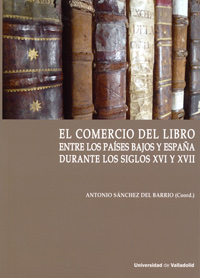
THE BOOK TRADE BETWEEN THE LOW COUNTRIES AND SPAIN DURING THE SIXTEENTH AND SEVENTEENTH CENTURIES
Synopsis
Among the objectives of the Simón Ruiz Chair, established in 2012 through an agreement between the Fundación Museo de las Ferias de Medina del Campo and the University of Valladolid, is the promotion of scholarly research concerning the international prominence of the Castilian fairs during the fifteenth to seventeenth centuries. This agreement was subsequently complemented by those signed in 2013 with the Miguel de Cervantes Virtual Library Foundation and Banco Santander, through its Santander-Universities Global Division, for the purpose of subsidizing and disseminating the resulting research. The volume currently held by the reader is the product of these projects. It examines a less explored facet of fair activity: the book trade. Traditionally, references to the Fairs of Medina del Campo emphasize their significance as international hubs for the negotiation of commodities and capital, as well as the primary location for the settlement of credit instruments for both private individuals and the Royal Treasury. However, alongside these activities, books and paper constituted another category of products exchanged in significant quantities. The reason for this phenomenon, in addition to the economic prosperity of sixteenth-century Castile, is linked to the settlement in the town of Medina of several French bookselling companies, many of which were subsidiaries of firms based in Lyon. These entities were responsible for purchasing books—in reams—from various printing centers and fairs across Europe and transporting them to Medina, where customers had them bound according to their preferences. Regardless of the substantial economic volume involved, this book trade also transformed the fairs into one of the most vital centers for cultural intermediation. Booksellers from Alcalá, Valladolid, Salamanca, Seville, and other regions of Spain and Portugal converged there to acquire copies of new works and reprints, generally written in Latin and published in Paris, Rome, Bologna, Louvain, Lyon, and elsewhere. In summary, this subject expands the field of research regarding Medina del Campo, its merchants, and its businessmen, where economic history intersects with cultural history.
One of the primary commercial circuits of the Castilian fairs was that which connected the Iberian Peninsula with Bruges, Antwerp and, by extension, the entirety of the Low Countries. Numerous publications exist on this subject, many of which are based on documentation from Belgian archives and, most notably, on the thousands of letters received by Simón Ruiz from Flanders and Brabant. Nevertheless, although this merchant and financier did not entirely abstain from the book and paper trade, such business was primarily conducted by other parties. This is the landscape described within these pages, where distinguished Dutch and Spanish specialists demonstrate that these exchanges were more extensive than previously assumed. Within this context, renowned printers such as the eminent Christophe Plantin appear alongside minor figures of diverse origins. Furthermore, the analysis of this commerce—encompassing both legal and prohibited books—permits a more faithful reconstruction of the flow of ideas in sixteenth- and seventeenth-century Europe. The perspective even broadens as, from Medina del Campo and Seville, the geography extends to the entire Ibero-American world. Consequently, new paths of inquiry are presented for exploration.
How to cite: Sánchez del Barrio, Antonio (2016). El comercio del libro entre los Países Bajos y España durante los siglos XVI y XVII. Valladolid: Ediciones Universidad de Valladolid.
Subjects:
Featured Subject: NHTB: Social and Cultural History
Featured Subject: KCZ: Economic History
Featured Subject: HBJ: Regional and National History
Featured Subject: HBG: General and World History