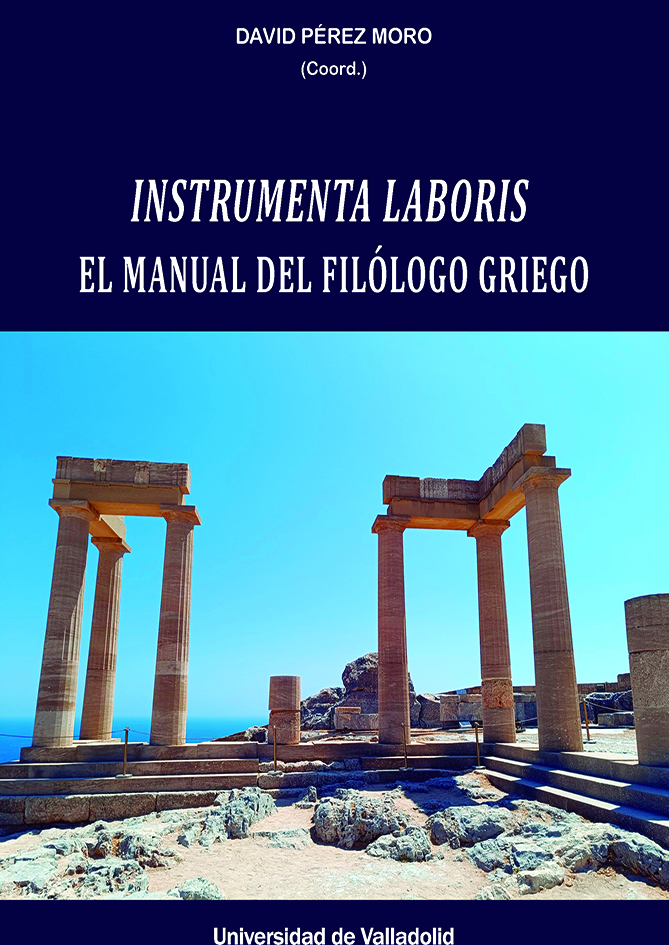
Instrumenta Laboris: The Manual of the Greek Philologist
Keywords:
Classical Philology, Greek, Research, Bibliography, Computer ResourcesSynopsis
The aim of this volume is to fill a gap in the field of manuals of Greek Philology. These manuals address the different areas of knowledge within our discipline in a theoretical manner, that is, with a research purpose and for an experienced audience. However, as a consequence of this objective by their authors, these manuals tend to omit the more general bibliographic sources. The omission of this type of bibliography creates greater difficulty and effort for students or novice researchers, in our case, of Greek Philology. These, as a result of new —and, in some cases, restricted— curricula, sometimes do not manage to approach this more general bibliography.
References
AE = Année épigraphique (1888-), París, Presses universitaires de France.
Agati, L. (2000), «Pietro Devaris di Corfù, "Scriba Librarius Vaticanus": l’identificazione di uno Pseudo-Onorio», en S. Patoura (ed.), Ἡ ἑλληνικὴ γραφὴ κατὰ τοὺς 15ους καὶ 16ους αἰῶνες, Atenas, National Hellenic Research Foundation, Institute for Byzantine Research, pp. 215-259.
Agati, M. L. (1992), La minuscola «bouletée», 2 vols., Ciudad del Vaticano, Scuola Vaticana di Paleografia, Diplomatica e Archivistica.
Agati, M. L. (2009), Il libro manoscritto da Oriente a Occidente: per una codicologia comparata, Roma, L’erma di Bretschneider.
Agazzi, Pierangelo y Massimo Vilardo (20235), Ἑλληνιστί: corso di lingua e cultura greca, 2 vols., Roma, Zanichelli.
Aguilar Fernández, Rosa María (2008), «Literatura de época imperial», en Francisco Rodríguez Adrados, José Antonio Berenguer Sánchez, Eugenio Luján Martínez y Juan Rodríguez Somolinos (eds.), Veinte años de filología griega (1984-2004), Madrid, Consejo Superior de Investigaciones Científicas, pp. 525-548.
Alcock, Susan E. y Robin Osborne (ed.) (2012), Classical Archaeology, Oxford, John Wiley and Sons.
Allen, T. W. (1899), Notes on abbreviations in Greek manuscripts, Oxford, Clarendon Press.
Altripp, Michael, Lars Hoffmann y Christos Stavrakos, Byzantioς. Studies in Byzantine History and Civilization (eds.) https://www.brepols.net/series/sbhc#publications (última consulta: 4 de mayo de 2024).
Amado Rodríguez, M. T. (2009), Luciano. Pleito entre las consonantes la Sigma contra la Tau ante las siete vocales; Pseudosofista o Solecista, Madrid, Cátedra.
Amato, Eugenio y Gianluca Ventrella (2009), I Progimnasmi di Severo di Alessandria (Severo di Antiochia?), Introduzione, traduzione e commento, Berlin and New York, De Gruyter. DOI: https://doi.org/10.1515/9783110218688.
Ambaglio, Delfino (2008), Storia della storiografia greca, Milano, Monduzzi Editoriale.
Andrewes, Antony (1963), The Greek Tyrants, Nueva York, Harper and Row.
Andrist, P., P. Canart y M. Maniaci (2013), La syntaxe du codex. Essai de codicologie structurale, Turnhout: Brepols.
Arnason, Johann P., Kurt A. Raaflaub, y Peter Wagner (ed.) (2013), The Greek Polis and the Invention of Democracy: A Politico‐cultural Transformation and Its Interpretations, Oxford, John Wiley and Sons. DOI: https://doi.org/10.1002/9781118561768 .
Astruc, C. (ed.) (1989), Les manuscrits grecs datés des XIIIe et XIVe siècles dans les bibliothèques publiques de France. Vol. 1, XIIIe siècle, París, Bibliothèque nationale de France.
Audollent, Auguste (1904), Defixionum tabellae quotquot innotuerunt, tam in Graecis Orientis quam in totius Occidentis partibus praeter Atticas in Corpore inscriptionum atticarum editas, París, A. Fontemoing. Disponible en https://archive.org/details/defixionumtabel00audogoog (fecha de consulta: 22 de marzo de 2024).
Aujac, Germaine (2002a), Denys D’Halicarnasse, Opuscules Rhétoriques, Tome I, Los orateurs antiques, Paris, Les Belles Lettres.
Aujac, Germaine (2002b), Denys D’Halicarnasse, Opuscules Rhétoriques, Tome II, Démosthène, Paris, Les Belles Lettres.
Aujac, Germaine (2002c), Denys D’Halicarnasse, Opuscules Rhétoriques, Tome IV, Thucydide; Seconde lettre à Ammée, Paris, Les Belles Lettres.
Aujac, Germaine (2002d), Denys D’Halicarnasse, Opuscules Rhétoriques, Tome V, L’imitation (fragments, Épitomé); Première lettre à Ammée; Lettre a Pompée Géminos; Dinarque, Paris, Les Belles Lettres.
Aujac, Germaine y Maurice Lebel (2003), Denys D’Halicarnasse, Opuscules Rhétoriques, Tome III, La composition stylistique, Paris, Les Belles Lettres.
Aura Jorro, Francisco, (1993). Diccionario micénico: Diccionario Griego-Español anejos I–II. 2 vols. Madrid: Consejo Superior de Investigaciones Científicas.
Aura Jorro, Francisco, Alberto Bernabé, Eugenio R. Luján, Juan Piquero y Carlos Varias García (2020), Diccionario Griego-Español. Suplemento al Diccionario Micénico: 7 (Anejo Diccionario Griego Español), Madrid, Consejo Superior de Investigaciones Científicas.
Azaustre Galiana, Antonio y Juan Casas Rigall (1997), Manual de retórica española, Barcelona, Planeta.
Bach Pellicer, R. (1977), Marco Aurelio. Meditaciones. Introducción de C. García Gual, Madrid, Gredos.
Bailly, Anantole (2020 [1901]), Dictionnaire Grec–Français. Disponible en: https://bailly.app/ (fecha de consulta: 28 de marzo de 2024).
Bakker, Egbert (ed.) (2010), A Companion to the Ancient Greek Language, Cambridge:, Cambridge University Press, https://doi.org/10.1002/9781444317398.
Barber, Eric A., Paul Maas, Mark Scheller, y Martin L. West (eds.) (1968), Greek-English lexicon: A supplement. Oxford, Oxford Clarendon Press.
Barbour, R. (1981), Greek Literary Hands a.D. 400 – 1600, Oxford, Clarendon Press.
Barchiesi, M. (1974), Palladio. La storia Lausiaca, Milán, Mondadori.
Barringer, Judith M. (2015), The Art and Archaeology of Ancient Greece, Cambridge, Cambridge University Press. DOI: https://doi.org/10.1017/CBO9781139047418 .
Bartelink, G. J. M. (1974), Vita di Antonio, Milán, Mondadori.
Baurain, Claude (1997), Les Grecs et la Méditerranée orientale. Des «siècles obscurs» à la fin de l'époque archaïque, París, Presses Universitaires de France. DOI: https://doi.org/10.3917/puf.baura.1997.01 .
Bautista Ruiz, H. (2011), «La escritura de la lengua griega desde sus primeros testimonios hasta la difusión del libro impreso», Thamyris, n. s. 2, pp. 81-103.
Bearzot, Cinzia (2022), Storiografia greca. Un’introduzione, Bologna, Il Mulino.
Bechtel, Friedrich (1921–1924), Die Griechischen Dialekte. Erster Band: Der lesbische, thessalische, böotische, arkadische und kyprische Dialekt. Zweiter Band: Die Westgriechischen Dialekte. Dritter Band: Der ionische Dialekt, Berlin, Weidmannsche Buchhandlung.
Beck, Hans (ed.) (2013), A Companion to Ancient Greek Government, Oxford, Blackwell. DOI: https://doi.org/10.1002/9781118303214 .
Beekes, Robert (2010), Etymological Greek Dictionary, Leiden/Boston, Brill.
Bekker, Immanuel (1837), Aristotelis De Rhetorica libri III, Rhetorica ad Alexandrum, De Poetica, Oxford, E Typographeo Academico.
Beneker, Jeffrey y Craig Gibson (2016), The Rhetorical Exercises of Nikephotos Basilakes, Progymnasmata from Twelfth Century Byzantium, Harvard, Dumbarton Oaks.
Bengtson, Hermann (2009), Griechische Geschichte, Munich, C.H. Beck.
Bérard, Françoise; Feissel, Denis; Laubry, Nicolas; Petitmengin, Pierre; Rousset, Denis; y Michel Sève et coll. (2000), Guide de l’épigraphiste. Bibliographie choise des épigraphies antiques et médiévales, París, Rue d’Ulm.
Berardi, Francesco (2018), La retorica degli esercizi preparatori. Glossario ragionato dei Progymnásmata, Zurich and New York, Georg Olms Verlag Hildesheim.
Bernabé Pajares, Alberto (1979), Fragmentos de la épica arcaica, Madrid, Gredos.
Bernabé Pajares, Alberto (1998), Aristóteles, Retórica, Madrid, Alianza.
Bernabé, Alberto y Eugenio Luján (2006), Introducción al Griego Micénico. Gramática, selección de textos y glosario, Zaragoza, Prensas Universitarias de Zaragoza.
Bernabé, Alberto y Eugenio R. Luján (2006), Introducción al griego-micénico: gramática, selección de textos y glosario, Zaragoza, Prensas Universitarias de Zaragoza.
Bernand, André y Étienne Bernand (1960), Les inscriptions grecques et latines du Colosse de Memnon, París, Institut Français d’Archéologie Orientale.
Bernand, Étienne (1982-1983), Inscriptions grecques d’Égypte et de Nubie. Répertoire bibliographique des OGIS, París, Les Belles Lettres, https://doi.org/10.3406/ista.1982.1192
Bertrand, Joëlle (2007), Vocabulaire grec. Du mot à la pensée, Paris, Ellipses.
Bertrand, Joëlle (2008), La grammaire grecque par l'exemple. Nouvelle édition, Paris, Ellipses.
Bertrand, Joëlle (20103), Nouvelle Grammaire Grecque, Paris, Ellipses.
Betalli, Marco (2021), Introduzione alla storiografia greca, Roma, Carocci editore.
Betancourt, Phillip P. (2007), Introduction to Aegean Art, Filadelfia, INSTAP Academic Press. DOI : https://doi.org/10.2307/j.ctt5vj92r .
Bianchetti, Serena, Michele Cataudella y Hans-Joachim Gehrke (ed.) (2015), Brill's Companion to Ancient Geography, Leiden, Brill. DOI: https://doi.org/10.1163/9789004284715 .
Biers, William R. (1997), Archaeology of Greece. An Introduction, Ithaca, Cornell University Press.
Billows, Richard A. (1990), Antigonos the One-Eyed and the Creation of the Hellenistic State, Berkeley, University of California Press. DOI: https://doi.org/10.1525/9780520919044 .
Bing, Peter y Jon S. Bruss (2007), Brill’s Companion to Hellenistic Epigram, Leiden y Boston, Brill, https://doi.org/10.1163/9789047419402.
Bintiff, John (2012), The Complete Archaeology of Greece: From Hunter-Gatherers to the 20th Century A.D., Oxford, Blackwell. DOI: https://doi.org/10.1002/9781118255179 .
Bispham, Edward, Thomas Harrison y Brian A. Sparkes (ed.) (2010), The Edinburgh Companion to Ancient Greece and Rome, Edimburgo, Edinburgh University Press.
Blanchard, A. (1977), «Les origines lointaines de la minuscule», en La Paléographie grecque et byzantine. París, Editions du CNRS, pp. 167-173.
Blanchard, A. (ed.) (1989), Les débuts du codex. Actes de la journée d’études organisée à Paris les 3 et 4 juillet 1985. Turnhout, Brepols.
Boardman, John (1978), Greek Sculpture: The Archaic Period, Londres, Thames and Hudson.
Boardman, John (1978b), Pre-Classical: From Crete to Archaic Greece, Londres, Penguin.
Boardman, John (1985), Greek Art, Londres, Thames and Hudson.
Boardman, John (1985b), The Parthenon and Its Sculptures, Londres, Thames and Hudson.
Boardman, John (1987), Greek Sculpture: The Classical Period, Londres, Thames and Hudson.
Boardman, John (1999), The Greeks Overseas: Their Early Colonies and Trade, Londres, Thames and Hudson.
Boardman, John (2006), The History of Greek Vases: Potters, Painters and Pictures, Londres, Thames and Hudson.
Boardman, John (ed.) (1994), Oxford History of Classical Art, Oxford University Press, Oxford.
Boardman, John, Jasper Griffin y Oswyn Murray (2001), The Oxford History of Greece and the Hellenistic World, Oxford, Oxford University Press. DOI: https://doi.org/10.1093/oso/9780192801371.001.0001 .
Bonifaz Nuño, R. (2020), Homero. Ilíada, México, Universidad Nacional Autónoma de México.
Bons, Jeroen (2007), «Gorgias the Sophist and Early Rhetoric», en Ian Worthington (ed.), A Companion to Greek Rhetoric, Malden, Oxford and Carlton, Blackwell Publishing, pp. 37-46.
Bornemann, Edouard y Risch, Ernst, Griechische Grammatik, (1978), Berlin, Diesterweg.
Borza, Eugene N. (1990), In the Shadow of Olympus: The Emergence of Macedon, Princeton, Princeton University Press. DOI: https://doi.org/10.1515/9780691215945 .
Bosworth, Brian A. (2002), The Legacy of Alexander: Politics, Warfare and Propaganda under the Successors, Oxford, Oxford University Press. DOI : https://doi.org/10.1093/acprof:oso/9780198153061.001.0001 .
Boter, G. (2022), Flavius Philostratus. Vita Apollonii Tyanei, Berlín-Boston, De Gruyter. https://doi.org/10.1515/9783110262131
Bravo García, A. (1984a), «La paleografía griega hoy». En A. Martínez Díez (coord.), Actualización científica en Filología Griega, Madrid, Universidad Complutense, pp.1-64.
Bravo García, A. (1984b), «Una ojeada a la codicología griega», en A. Martínez Díez (coord.) Actualización científica en Filología Griega, Madrid, Universidad Complutense, pp. 65-79.
Briand, M. (2021), Pindare. Olympiques, París, Les Belles Letres.
Briant, Pierre (2016), Alexandre: Exégèse des lieux communs, París, Gallimard. DOI : https://doi.org/10.14375/NP.9782070793761 .
Briant, Pierre et al. (1995), Le monde grec aux temps classiques I: Le Ve siècle, París, Presses Universitaires de France.
Brioso Sánchez, Máximo y Francisco Javier González Ponce (eds.) (1996), Las letras griegas bajo el Imperio, Zaragoza, Pórtico.
Briquet, C. (1923), Les Filigranes. Dictionnaire Historique des Marques du Papier dés leur apparition vers 1282 jusqu’en 1600, Leipzig, Verlag von Karl. W. Hiersemann (reimpr. Hildesheim – Nueva York, Georg Olm, 1977). Disponible en: https://memoryofpaper.eu/briquet/BR.php (fecha de consulta: 23 de marzo de 2024).
Brommer, Frank (1979), The sculptures of the Parthenon, Londres, Thames and Hudson.
Brulé, Pierre et al. (2004), Le monde grec aux temps classiques II: Le IVe siècle, París, Presses Universitaires de France. DOI: https://doi.org/10.3917/puf.brule.2004.01 .
Brunelle, C. M. (2015), Ovid. Ars amatoria, book three. Corby, Oxford University Press.
Bruun, Christer y Jonathan Edmonson (2015), «The Epigrapher at Work», en Christer Bruun y Jonathan Edmonson (ed.), The Oxford Handbook of Roman Epigraphy, Oxford, Oxford University Press, pp. 3-20, https://doi.org/10.1093/oxfordhb/9780195336467.013.001
Buck, Carl D. (1955), The Greek Dialects. Chicago: University of Chicago Press (edición anterior: Introduction to the Study of the Greek Dialects, (2010), Boston, Ginn & Company).
Buck, Carl Darling (1955), The Greek Dialects, Bristol, Bristol Classical Press.
Budelmann, Felix (ed.) (2009), The Cambridge Companion to Greek Lyric, Cambridge, Cambridge University Press, https://doi.org/10.1017/CCOL9780521849449.
Bugh, Glenn R. (ed.) (2006), The Cambridge Companion to the Hellenistic World, Cambridge, Cambridge University Press. DOI: https://doi.org/10.1017/CCOL0521828791 .
Buijs, Michel (2016), A Bibliography of Ancient Greek Linguistics: Leiden University. Disponible en: https://hum2.leidenuniv.nl/bibliography-of-greek-linguistics/bgl.html (fecha de consulta: 25 de marzo de 2024).
Burkert, Walter (1998), The Orientalizing Revolution, Harvard, Harvard University Press.
Bushnell, Rebecca (2005), A Companion to Tragedy, New Jersey, Wiley-Blackwell, https://doi.org/10.1111/b.9781405107358.2005.00001.x.
Caballero López, José A. (2006), Inicios y desarrollo de la historiografía griega, Madrid, Síntesis.
Cagnat, René (1906-1927), Inscriptiones Graecae ad res Romanas pertinentes, 3 vols., París, Ernest Leroux. Disponible en https://archive.org/details/inscriptionesgra04cagnuoft/page/n7/mode/2up (fecha de consulta: 22 de marzo de 2024).
Calderini, Aristide (1974), Epigrafia, Turín, Società Editrice Internazionale.
Calvo Martínez, J. L. y J. M García Valverde (2022), Aristóteles. Física, Madrid, CSIC.
Cambiano, Giuseppe, Canfora, Luciano y Lanza, Diego (1992-1996), Lo spazio letterario della Grecia antica, Roma, Salerno.
Camp, John M. (2001), The Archaeology of Athens, New Haven, Yale University Press.
Canart, P. (1963), «Scribes Grecs de la Renaissance. Additions et corrections aux répertoires de Vogel-Gartdhausen et de Patrinélis», Scriptorium, 17, pp. 56-82. DOI: https://doi.org/10.3406/scrip.1963.3165.
Canart, P. (1964), «Les manuscrits copiés par Emmanuel Provataris (1546-1570 environ). Essai d’étude codicologique», Mélanges Eugène Tisserant, 6, pp. 173-287.
Canart, P. (1977), «Identification et différenciation de mains à l’époque de la Renaissance», en La Paléographie Grecque et Byzantine, París, Editions du CNRS, pp. 363-369.
Canart, P. (1980), Lezioni di Paleografia e di Codicologia greca, Ciudad del Vaticano. Disponible en: http://pyle.it/bookshelf/texts-on-pyle/ (fecha de consulta: 23 de marzo de 2024).
Canart, P. (1991), Paleografia e codicologia greca: una rassegna bibliografica, Ciudad del Vaticano, Scuola Vaticana di Paleografia, Diplomatica e Archivistica.
Canart, P. y J. Leroy (1977), «Les manuscrits en style de Reggio. Étude Paléographique et codicologique», en La Paléographie Grecque et Byzantine, París, Editions du CNRS, pp. 241-261.
Canart, P. y L. Perria (1991), «Les écritures livresques des Xie et XIIe siècles», en Paleografia e codicologia greca. Atti del II colloquio internazionale (Berlin-Wolfenbüttel, 17-21 ottobre 1983), Alessandia, Edizioni dell’Orso, pp. 67-118.
Canart, P., A. Jacob, S. Lucà y L. Perria (1998), Facsimili di codici greci della Biblioteca Vaticana, 1: Tavole, Ciudad del Vaticano, Biblioteca Apostolica Vaticana.
Cancik, Hubert y Helmuth Schneider (1996-2003), «Der neue Pauly. Enzyklopädie der Antike. Das klassische Altertum und seine Rezeptionsgeschichte». Disponible en https://referenceworks.brillonline.com/browse/der-neue-pauly (fecha de consulta: 4 de abril de 2024).
Cancik, Hubert y Helmuth Schneider (ed.) (1996-2003), Der neue Pauly. Enzyklopädie der Antike. Das klassische Altertum und seine Rezeptionsgeschichte, Stuttgart, J.B. Metzler.
Cancik, Hubert, Helmuth Schneider y Manfred Landfester (eds.) (1996 - 2003), Der Neue Pauly: Enzyklopädie der Antike, Stuttgart, J. B. Metzler.
Canfora, Luciano (1986), Storia della letteratura greca, Roma, Laterza.
Canfora, Luciano (1999), La storiografia greca, Milano, Bruno Mondadori.
Cannavò, Fabio (2014), Aristotele, Retorica, Milano, Bompiani.
Cano Cuenca, J. (2014), Platón. Carta VII, Madrid, Cátedra.
Cantarella, R. y F. Conca (1992), Poeti bizantini, Milán, Biblioteca Universale Rizzoli.
Carlier, Pierre (1984), La royauté en Grèce avant Alexandre, Estrasburgo, AECR.
Cartledge, Paul (2002), The Cambridge Illustrated History of Ancient Greece, Cambridge, Cambridge University Press.
Casetti-Brach, C. (1976), «Copisti greci del Medioevo e del Rinascimento. Aggiunte ai repertori di Vogel-Gardthausen, Patrinelis, Canart e Wiesner-Victor, dai fondi dell’Escorial», EHBS, 43, pp. 235-252.
Cassio, Albio C. (coord.) (20162), Storia delle lingue letterarie greche, Roma, Mondadori Education.
Castriota, David (1992), Myth, Ethos, and Actuality: Official Art in Fifth-century B.C. Athens, Madison, The University of Wisconsin Press.
Cataldi-Palau, A. (2000), «Bartolomeo Zanetti stampatore e copista di manoscritti», en S. Patoura (ed.), Ἡ ἑλληνικὴ γραφὴ κατὰ τοὺς 15ους καὶ 16ους αἰῶνες, Atenas, National Hellenic Research Foundation, Institute for Byzantine Research, pp. 83-114.
Cavallo, G. (1967), Ricerce sulla maiuscola biblica, Florencia, Le Monnier.
Cavallo, G. (2007), Leggere a Bisanzio. Milán, Sylvestre Bonnard.
Cavallo, G. (ed.) (1982), Libri e lettori nel mondo bizantino: Guida storica e critica, Roma, Laterza.
Cavallo, G. (ed.) (1988), Le biblioteche nel mondo antico e medievale, Roma – Bari, Laterza.
Cavallo, Guglielmo (2004), Lo spazio letteratio del Medioevo. La cultura bizantina, Roma, Salerno Editrice.
Cavallo, Guglielmo (2019), Leer en Bizancio, Buenos Aires y Madrid, Ampersand.
Celano, Giuseppe C. A. (2019), «The Dependency Treebanks for Ancient Greek and Latin», en Monica Berti (ed.), Digital Classical Philology. Ancient Greek and Latin in the Digital Revolution, Berlin-Boston, De Gruyter, pp. 279–298, https://doi.org/10.1515/9783110599572-016.
Chadwick, John (1958), The decipherment of Linear B, Cambridge, Cambridge University Press. Disponible en https://archive.org/details/ChadwickJohnTheDeciphermentOfLinearB1958 (fecha de consulta: 22 de marzo de 2024).
Chadwick, John (1976), The Mycenaean World, Cambridge, Cambridge University Press.
Chadwick, John. (1996), Lexicographica graeca: Contributions to the lexicography of Ancient Greek. Oxford, Oxford Clarendon Press, https://doi.org/10.1093/oso/9780198149705.001.0001.
Chandler, Clive (2006), Philodemus, On Rhetoric, Books 1 and 2, Translation and Exegetical Essays, New York and London, Routledge. DOI: https://doi.org/10.1080/15362426.2004.10557239.
Chantarine, Pierre (2005), Morphologie historique du grec, Paris, Klincksieck.
Chantraine, Pierre (1958), Grammaire Homérique. Tome I: Phonétique et Morphologie, Paris, Klincksieck.
Chantraine, Pierre (1963), Grammaire Homérique. Tome II: Syntaxe, Paris, Klincksieck
Chantraine, Pierre (1979), La Formation des noms en Grec Ancien, Paris, Klincksieck.
Chantraine, Pierre (ed.) (1999), Dictionnaire étymologique de la langue grecque. Histoire des mots, Paris, Kliensieck.
Childs, William A. P. (2018), Greek Art and Aesthetics in the Fourth Century B.C., Princeton, Princeton University Press. DOI: https://doi.org/10.1515/9781400890514 .
Chiron, Pierre (2002), Pseudo-Aristote, Rhétorique à Alexandre, Paris, Les Belles Lettres.
Chiron, Pierre (2007a), Aristote, Rhétorique, Paris, Flammarion.
Chiron, Pierre (2007b), «The Rhetoric to Alexander», en Ian Worthington (ed.), A Companion to Greek Rhetoric, Malden, Oxford and Carlton, Blackwell Publishing, pp. 90-106.
Chironweb. Disponible en https://sites.google.com/view/chironweb/ (fecha de consulta: 26 de marzo de 2024).
Christidis, Athanasios Ph. (2007), A History of Ancient Greek. From the Beginnings to Late Antiquity (traducción revisada de Ιστορία της ελληνικής γλώσσας: Από τις αρχές έως την ύστερη αρχαιότητα, Thessaloniki: Centre for the Greek Language and the Institute of Modern Greek Studies, 2001), Cambridge, Cambridge University Press.
CID = Corpus des inscriptions de Delphes (1977-), 5 vols., Atenas, Ècole Françaose d’Athènes.
CIG = Corpus Inscriptionum Graecarum (1828-1877), 4 vols., Berlín, Officina Academica. Disponible en https://archive.org/details/bub_gb_s5X4lUGIFBkC/page/n3/mode/2up (fecha de consulta: 22 de marzo de 2024).
Clackson, James (2007), Indo-European Linguistics: An Introduction, Cambridge, Cambridge University Press, https://doi.org/10.1017/CBO9780511808616.
Clauss, James J. y Martine Cuypers (eds.) (2010), A companion to Hellenistic literature, Chichester, Wiley-Blcakwell, https://doi.org/10.1002/9781118970577.
Coderch, Juan (1997), Diccionario español-griego, Madrid, Ediciones Clásicas.
Coderch, Juan (2012), Classical Greek: A New Grammar. Greek grammar taught and explained, with examples. Disponible en: http://coderch-greek-latin-grammar.weebly.com/ (fecha de consulta: 30 de marzo de 2024).
Coldstream, John N. (2003), Geometric Greece: 900-700 BC, Londres, Psychology Press.
Colvin, S. (2007), A Historical Greek Reader: Mycenaean to the Koiné. Oxford, Oxford University Press, https://doi.org/10.1093/oso/9780199226597.001.0001.
Concasty, M.-L. y C. Samaran (1969), «Christophe Auer, copiste de grec et de latin au XVIe siècle», Scriptorium, 23, pp. 199-214. DOI: https://doi.org/10.3406/scrip.1969.3365.
Congourdeau, M.-H. (2010), Correspondance de Nicolas Cabasilas, París, Les Belles Letres.
Cook, Brian Francis (1987), Greek Inscriptions. Reading the Past, California, University of California Press y British Museum. Disponible en https://archive.org/details/bub_gb_Kp806ShRDh8C (fecha de consulta: 22 de marzo de 2024).
Cordano, Federica (2002), La geografia degli antichi, Roma, Laterza.
Corpus Vasorum Antiquorum. Disponible en https://www.carc.ox.ac.uk/cva/ (fecha de consulta: 4 de abril de 2024).
Cortés Arrese, M. A. e I. Pérez Martín (eds.) (2008), Lecturas de Bizancio: el legado escrito de Grecia en España, Madrid, Biblioteca Nacional.
Cortés Copete, Juan Manuel (1999), Epigrafía Griega, Madrid, Cátedra.
Crespo Güemes, E. (2019), Homero. Ilíada, Madrid, Gredos.
Crisci, E., y P. Degni (eds.) (2011), La scrittura greca dall’antichità all’epoca della stampa: una introduzione, Roma, Carocci. (Una edición revisada apareció en 2021: Bianconi, D, Crisci, E., y P. Degni (eds.) (2021), Paleografia greca, Roma: Carocci.).
Cruse, Alan (1986), Lexical Semantics, Cambridge, Cambridge University Press.
Cullhed, Eric (2019), Eustathios of Thessalonike: Parekbolai of Homer’s Odyssey 1-2: Proekdosis, Uppsala, Uppsala Universitet.
Cunliffe, Richard J. (19632), A lexicon of the Homeric dialect, University of Oklahoma Press.
Curbera, J. (ed.) (próximamente), Inscriptiones Graecae XVI. Inscriptiones Atticae. Defixiones Atticae. Berlín: De Gruyter.
D’Agostino, M. (1997), La minuscola «tipo Anastasio» dalla scritura alla decorazione, Bari, Levante.
D’Agostino, M. (2009), «La scrittura di Giovanni Santamaura», Segno e Testo, 7, pp. 301-340.
Dain, A. (1949), Les Manuscrits, París, Les Belles Lettres. DOI: http://10.4000/books.lesbelleslettres.11395 (vista parcial).
Danker, Frederick William (20003), A Greek-English lexicon of the New Testament and other early Christian literature (BDAG), Chicago, University of Chicago Press.
Daremberg, Charles V. y Edmond Saglio (1877-1919), «Dictionnaire des Antiquités grecques et romaines». Disponible en https://dagr.univ-tlse2.fr/ (fecha de consulta: 4 de abril de 2024).
Daremberg, Charles V. y Edmond Saglio (eds.) (1877-1919), Dictionnaire des Antiquités grecques et romaines, París, Hachette.
Davies, John y John Wilkes (ed.) (2012), Epigraphy and the Historical Sciences, Oxford, Oxford University Press, https://doi.org/10.5871/bacad/9780197265062.001.0001
Davies, Malcolm (2001), The Greek Epic Cycle, Bristol, Bristol Classical Press.
de Gregorio, G. (1991), Il copista greco Manouel Malaxos: Studio biografico e paleografico-codicologico, Ciudad del Vaticano, Scuola Vaticana di Paleografia, Diplomatica e Archivistica.
de Hoz, María Paz (2008), «Epigrafía», en Francisco Rodríguez Adrados, José Antonio Berenguer Amenós, Eugenio Ramón Luján Martínez y Juan Rodríguez Somolinos (ed.), Veinte años de filología griega (1984-2004), Madrid, CSIC, pp. 37-61. Disponible en https://books.google.es/books/about/Veinte_años_de_filología_griega_1984_2.html?id=sDPcBJYDZ50C&redir_esc=y (fecha de consulta: 22 de marzo de 2024).
de Meyier, K. A. (1964), «Scribes Grecs de la Renaissance. Additions et corrections aux répertoires de Vogel-Gardthausen, de Patrinélis et de Canart», Scriptorium, 18, pp. 258-266. DOI: https://doi.org/10.3406/scrip.1964.3215.
del Barrio Vega, María Luisa (1992), Epigramas funerarios griegos, Madrid, Gredos.
Del Corso, L. (2022), Il libro nel mondo antico. Archeologia e storia (secoli VII a.C.-IV d.C.), Roma, Carocci.
Del Freo, Maurizio y Massimo Perna (eds.) (2016), Manuale di epigrafia micenea: Introduzione allo studio dei testi in lineare B, 2 vols., Padova, Libreriauniversitaria.it edizioni.
Dewing H. B. (1914), Procopius. History of the Wars. Volume I: Books 1-2, Cambridge (MA), Harvard University Press. https://doi.org/10.4159/DLCL.procopius-history_wars.1914
Dewing H. B. (1916a), Procopius. History of the Wars. Volume II: Books 3-4, Cambridge (MA), Harvard University Press.
Dewing H. B. (1916b), Procopius. History of the Wars. Volume III: Books 5-6.15, Cambridge (MA), Harvard University Press.
Dewing H. B. (1924), Procopius. History of the Wars. Volume IV: Books 6.16-7.35, Cambridge (MA), Harvard University Press.
Dewing H. B. (1928), Procopius. History of the Wars. Volume V: Books 7.36-8, Cambridge (MA), Harvard University Press.
Dewing H. B. (1935), Procopius. The Anecdota or Secret History. Cambridge (MA), Harvard University Press. https://doi.org/10.4159/DLCL.procopius-anecdota_secret_history.1935
Dewing H. B. (1940), Procopius. On Buildings. General Index, Cambridge (MA), Harvard University Press. https://doi.org/10.4159/DLCL.procopius-buildings.1940
Di Benedetto, Vincenzo y Enrico Medda (1996), La tragedia sulla scena. La tragedia greca in quanto spettacolo teatrale, Torino, Giulio Einaudi.
Di Marco, Massimo (2000), La tragedia greca. Forma, gioco scenico, techniche dramatiche, Roma, Carocci.
di Stefano Manzella, Ivan (1987), Mestiere di epigrafista. Guida alla schedatura del materiale epigrafico lapideo, Roma, Quasar.
Dickey, Eleanor (2007), Ancient Greek Scholarship. A Guide to Finding, Reading, and Understanding Scholia, Commentaries, Lexica, and Grammatical Treatises, from their Beginnings to the Byzantine Period, Oxford, Oxford University Press, https://doi.org/10.1093/oso/9780195312928.001.0001.
Dickinson, Oliver T. P. K. (2006), The Aegean from Bronze Age to Iron Age, Londres Routledge. DOI: https://doi.org/10.4324/9780203968369 .
Diggle, James (ed.) (2021), The Cambridge Greek Lexicon, Cambridge, Cambridge University Press.
Dilts, Mervin y George Kennedy (1997), Two Greek Rhetorical Treatises from the Roman Empire. Introduction, Text, and Translation of the Arts of Rhetoric Attributed to Anonymous Seguerianus and to Apsines of Gadara, Leiden, New York and Köln, Brill.
Dittenberger, Wilhelm (1917-1920), Sylloge Inscriptionum Graecarum, 4 vols., Leipzig, S. Hirzelium. Disponible en https://archive.org/details/syllogeinscripti02dittuoft/page/n5/mode/2up (fecha de consulta: 22 de marzo de 2024).
Domínguez Monedero, Adolfo J. (1991), La polis y la expansión colonial griega (siglos VIII-VI), Madrid, Síntesis.
Domínguez Monedero, Adolfo J. (1996), Los griegos en la Península Ibérica, Madrid, Arco Libros.
Dueck, Daniela (2012), Geography in Classical Antiquity, Cambridge, Cambridge University Press. DOI: https://doi.org/10.1017/CBO9781139027014 .
Duhoux, Yves (1983), Introduction aux dialectes grecs anciens: Problèmes et méthodes. Recueil de textes traduits, Louvain-la-neuve, Cabay.
Duhoux, Yves (20002), Le Verbe Grec Ancien: Elements De Morphologie et De Syntaxe Historiques: Deuxieme Edition, Revue Et Augmentee: Eléments de morphologie et de syntaxe historiques, Louvain-la-neuve, Peeters.
Duhoux, Yves y Anna Morpurgo Davies (eds.) (2008), A Companion to Linear B: Mycenaean Greek Texts and their World, Volume I, Louvain-la-neuve: Peeters.
Duhoux, Yves y Anna Morpurgo Davies (eds.) (2011), A Companion to Linear B: Mycenaean Greek Texts and their World, Volume II, Louvain-la-neuve, Peeters.
Duhoux, Yves y Anna Morpurgo Davies (eds.) (2014), A Companion to Linear B: Mycenaean Greek Texts and their World, Volume III, Louvain-la neuve: Peeters.
Dunbabin, Katherine M. D. (2006), Mosaics of the Greek and Roman World, Cambridge, Cambridge University Press.
Easterling, Patricia E. (ed.) (1997), The Cambridge Companion to Greek Tragedy, Cambridge, Cambridge University Press, https://doi.org/10.1017/CCOL0521412455.
Easterling, Patricia E. y Bernard M. W. Knox (1989), The Cambridge History of Classical Literature: Volume 1, Greek Literature, Cambridge, Cambridge University Press.
Easterling, Patricia E. y Bernard M. W. Knox (1991), Historia de la Literatura Clásica, Volumen I: Literatura Griega, Madrid, Gredos.
EBGR = Epigraphic Bulletin for Greek Religion (1993-), Kernos. Disponible en https://journals.openedition.org/kernos/605?lang=en (fecha de consulta: 13 de febrero de 2024).
Eco, Umberto (1968), La struttura assente, Milano, Bompiani.
Efthymiadis, Stephanos (ed.) (2002 y 2020), The Ashgate Research Companion to Byzantine Hagiography, Volumen I: Periods and Places (2002 en Ashgate, 2011 en Routledge) y Volumen II: Genres and contexts (2020), London y New York, Routledge, https://doi.org/10.4324/9781315141909.
Egea Sánchez, José Mª (1988), Documenta selecta ad historiam linguae graecae ilustrandam (vol. 1), Bilbao, Universidad del País Vasco.
El-Abbadi, Mostafa y Omnia M. Fathallah (2008), What happened to the ancient library of Alexandria? Leiden y Boston, Brill, https://doi.org/10.1163/ej.9789004165458.i-259.
Elvira Barba, Miguel Ángel (1996), El arte clásico, Madrid, Historia 16.
Elvira Barba, Miguel Ángel (2008), Arte y mito: manual de iconografía clásica, Madrid, Sílex.
Elvira Barba, Miguel Ángel (2013), Manual de Arte Griego, Madrid, Sílex.
Elvira Barba, Miguel Ángel (2019), Historia del arte griego: Obras y artistas de la antigua Grecia, Madrid, Escolar y Mayo.
Epigraphica. Periodico internazionale di epigrafia (1939-), Sassari, Carocci. Disponible en https://www.epigraphica.it/volumi/ (fecha de consulta: 22 de marzo de 2024).
Errington, Malcom R. (2008), A History of the Hellenistic World: 323-30 BC, Oxford, John Wiley and Sons.
Erskine, Andrew (ed.) (2005), A Companion to the Hellenistic World, Oxford, Blackwell. DOI: https://doi.org/10.1002/9780470996584 .
Escobar Chico, Á. (2008), «1. Paleografía y Codicología», en F. R. Adrados, J. A. Berenguer, E. R. Luján y J. Rodríguez Somolinos (eds.), Veinte años de Filología Griega (1984-2004), Madrid, Consejo Superior de Investigaciones Científicas, pp. 11-36.
Espinosa Alarcón, A. (2022), Luciano. Historias Verdaderas. Prólogo de H. González Vaquerizo, Barcelona, Gredos.
Fantuzzi, Marco y Christos Tsagalis (eds.) (2015), The Greek Epic Cycle and its Ancient Reception, Cambridge, Cambridge University Press, https://doi.org/10.1017/CBO9780511998409.
Fernández Marcos, Natalio (2008) Septuaginta, la Biblia griega de judíos y cristianos, Salamanca, Sígueme.
Fernández Marcos, Natalio, Mª Victoria Spottorno y José M. Cañas (2008-2020) La Biblia griega Septuaginta, Salamanca, Sígueme.
Ferrini, Maria Fernanda (2015), [Aristotele], Retorica ad Alessandro, Milano, Bompiani.
Filkenberg, Margalit (ed.) (2011), The Homer Encyclopedia, Oxford, Blackwell Publishing.
Finkelberg, Margaret (ed.) (2011), The Homer Enciclopedia, New York, John Wiley, https://doi.org/10.1002/9781444350302.
Fisher, Elizabeth (2006), «Michael Psellos in a Hagiographical Landscape: The Life of St. Auxentios and the Encomium of Symeon the Metaphrast», en Charles Barber y David Jenkins (eds.), Reading Michael Psellos, Leiden, Brill, pp. 57-72. DOI: https://dx.doi.org/10.1163/9789047409809.
Follieri, E. (1969), Codices Graeci Bibliothecae Vaticanae Selecti, Ciudad del Vaticano, Biblioteca Apostolica Vaticana.
Fortenbaugh, William (2007), «Aristotle’s Art of Rhetoric», en Ian Worthington (ed.), A Companion to Greek Rhetoric, Malden, Oxford and Carlton, Blackwell Publishing, pp. 107-123.
Fortson, Benjamin W. (2010), Indo-European Language and Culture: An Introduction, Cambridge, Cambridge University Press.
Fouchard, Alain (1997), Aristocratie et Démocratie. Idéologies et sociétés en Grèce ancienne, París, Les Belles Lettres. DOI: https://doi.org/10.3406/ista.1998.1018 .
Fraser, Peter M. y Elaine Matthews (eds.) (1987-), Lexicon of Greek Personal Names, Oxford, Oxford Clarendon Press.
Freese, John Henry y Gisela Striker (2020), Aristotle, Art of Rhetoric, Harvard, Loeb Classical Library.
Frisk, Hjalmar (1960-1972), Griechisches Etymologisches Wörterbuch, 3 volúmenes, Heildelberg, Carl Winter.
Fuhrmann, Manfred (1966), Anaximenis ars rhetorica, Leipzig, Teubner.
Gagarin, Michael (2007), «Background and Origins: Oratory and Rhetoric before the Sophists», en Ian Worthington (ed.), A Companion to Greek Rhetoric, Malden, Oxford and Carlton, Blackwell Publishing, pp. 27-36.
Gagarin, Michael y David Cohen (2005), The Cambridge Companion to Ancient Greek Law, Cambridge, Cambridge University Press, https://doi.org/10.1017/CCOL0521818400.
Gager, John G. (1992), Curse Tablets and Binding Spells from the Ancient World, New York – Oxford, Oxford University Press, https://doi.org/10.1093/oso/9780195062267.001.0001
Gallavotti, C. (1974), Aristotele. Dell’arte poética, Milán, Mondadori.
Gallego, Julián (2003), La democracia en tiempos de tragedia: asamblea ateniense y subjetividad política, Barcelona, Miño y Dávila.
Gamillscheg, E., D. Harlfinger y H. Hunger (1989), Repertorium der griechischen Kopisten 800-1600. 2. Teil: Handschrfiten aus Bibliotheken Frankreichs und Nachträge zu den Bibliotheken Großbritanniens, Viena: Österreichische Akademie der Wissenschaften.
Gamillscheg, E., D. Harlfinger, H. Hunger y P. Eleuteri (1997), Repertorium der griechischen Kopisten 800-1600. 3. Teil: Handschriften aus Bibliotheken Roms mit dem Vatikan, Viena: Österreichische Akademie der Wissenschaften.
García Bueno, C. (2017), El copista griego Jacobo Diasorino (s. XVI): estudio paleográfico y codicológico de sus manuscritos, tesis doctoral, Universidad Complutense, Madrid. DOI: https://doi.org/10.5281/zenodo.3759835.
García Bueno, C. (2018), «Paleografía, codicología y crítica textual griegas». Disponible en: https://www.zotero.org/groups/2165949/paleografa_codicologa_y_crtica_textual_griegas (fecha de consulta: 23 de marzo de 2024).
García Gual, C. (1977), Pseudo-Calístenes. Vida y hazanas de Alejandro de Macedonia, Madrid, Gredos.
García Gual, Carlos (1988), Los orígenes de la novela, Madrid, Istmo.
García López, José (2008), «Literatura de época clásica», en Francisco Rodríguez Adrados, José Antonio Berenguer Sánchez, Eugenio Luján Martínez y Juan Rodríguez Somolinos (eds.), Veinte años de filología griega (1984-2004), Madrid, Consejo Superior de Investigaciones Científicas, pp. 479-502.
García Pinilla, I.J. (2016), Cicerón. Los deberes, Madrid, Gredos.
García-Alonso, J. L., M. P. de Hoz García-Bellido y S. Torallas Tovar (2016), Estrabón. Geografía. Libros XV-XVII, Madrid, Gredos.
Gardthausen, V. (1879), Griechische Paläographie, Leipzig, Veit. DOI: https://doi.org/10.1515/9783112603345.
Garzón Fontalvo, Eveling et al. (2023), Guía de anotación lingüística de textos grecolatinos / Guidelines for linguistic annotation of Graeco-Latin texts, Madrid, autoedición.
Gascó, Fernando, Manuel García García y Joaquín Gutiérrez Calderón (1996), Menandro el Rétor, Dos tratados de retórica epidíctica, Madrid, Gredos.
Géhin, P. (ed.) (2005a), Lire le manuscrit médiéval : observer et décrire. Paris, Armand Colin.
Géhin, P. (ed.) (2005b), Les manuscrits grecs datés des XIIIe et XIVe siècles conservés dans les bibliothèques publiques de France. Vol. 2, Première moitié du XIVe siècle, París, Bibliothèque nationale de France – Institut de recherche et d’histoire des textes.
Geraeerts. Dirk (1997), Diachronic Prototype Semantics : A Contribution to Historial Lexicology, Oxford, Oxford Clarendon Press, https://doi.org/10.1093/oso/9780198236528.001.0001.
Ghinatti, Franco (1998), Profilo di epigrafia greca, Rubbettino, Soveria Mannelli.
Giannakis, Georgios K. et al. (2013), Enciclopedy of Ancient Greek Language and Linguistics, Leiden/Boston, Brill.
GIBM = The Collection of Greek Inscriptions in the British Museum (1874-1916), 4 vols., Oxford, Clarendon Press. Disponible en https://archive.org/details/GIBMIIVGreekInscriptionsInTheBritishMuseum4VolumesIn1File (fecha de consulta: 22 de marzo de 2024).
Gibson, Craig (2008), Libanius’ Progymnasmata, Model Exercises in Greek Prose Composition and Rhetoric, Atlanta, Society of Biblical Literature.
Gil, Luis (2009) De Aristófanes a Menandro, Madrid, Ed. Clásicas.
Givón, Talmy (1995), Functionalism and Grammar, Amsterdam-Phidalelphia, John Benjamins, https://doi.org/10.1075/z.74.
Glare, Peter G. W y Anna A. Thompson (eds.) (1996), Greek-English lexicon : Revised supplement, Oxford, Oxford Clarendon Press.
Gómez Espelosín, Francisco Javier (2000), El descubrimiento del mundo. Geografía y viajeros en la antigua Grecia, Madrid, Akal.
Gómez Robledo, A (1994), Aristóteles. Ética eudemia, México, Universidad Nacional Autónoma de México.
Gómez Robledo, A (2012), Aristóteles. Ética nicomaquea, México, Universidad Nacional Autónoma de México.
Gómez Robledo, A (2018), Aristóteles. Política, México, Universidad Nacional Autónoma de México.
González, José M. (2013), The Epic Rhapsode and his Craft: Homeric Performance in a Diachronic Perspective, Washington D.C., Center for Hellenic Studies - Harvard Univeristy Press, disponible en http://nrs.harvard.edu/urn-3:hul.ebook:CHS_GonzalezJ.The_Epic_Rhapsode_and_his_Craft.2013, (última consulta: 4 de mayo de 2024).
Grammateion = Grammateion – ΓΡΑΜΜΑΤΕΙΟΝ. Electronic Journal on Ancient Greek Epigraphy, Topography and history - Ἠλεκτρονικὸ περιοδικὸ ἀρχαίαξ ἑλληνικῆς ἐπιγραφικῆς, τοπογραφίας καὶ ἱστορίας (2012-). Disponible en https://grammateion.gr/en/the-journal (fecha de consulta: 14 de febrero de 2024).
Grandjean, Catherine, Geneviève Hoffmann, Laurent Capdetrey y Jean-Yves Carrez-Maratray, (ed.) (2008), Le monde hellénistique, París, Armand Coline. DOI: https://doi.org/10.3917/arco.grand.2008.01 .
Graux, C. (1982), Los orígenes del fondo griego del Escorial (trad. de G. de Andrés), Madrid, Fundación Universitaria Española.
Graziosi, Barbara (2002), Inventing Homer, Cambridge, Cambridge University Press.
Graziosi, Barbara (2016), Homer, Oxford, Oxford University Press.
Greek-Language.com. Disponible en: https://greek-language.com/#gsc.tab=0 (fecha de consulta: 26 de marzo de 2024).
Green, Peter (1990), Alexander to Actium: The Historical Evolution of the Hellenistic Age, Berkeley, University of California Press.
Gregory, Justina (ed.) (2005), A Companion to Tragedy, New Jersey, Wiley-Blackwell, https://doi.org/10.1002/9780470996676.
Grimaldi, William (1980), Aristotle, Rhetoric I, A Commentary, New York, Fordham University Press.
Grimaldi, William (1988), Aristotle, Rhetoric II, A Commentary, New York, Fordham University Press.
Grumel, V. (1958), La chronologie, París, Presses Universitaires de France. DOI: https://gallica.bnf.fr/ark:/12148/bpt6k33309949.
Grupo de Lingüística del CSIC. Disponible en: https://glg.csic.es/ (fecha de consulta: 28 de marzo de 2024).
Guarducci, Margherita (1935-1950), Inscriptiones Creticae, opera et consilio Friderici Halbherr collectas, 4 vols., Roma, Librería dello Stato. Disponible en https://anemi.lib.uoc.gr/metadata/2/2/0/metadata-203-0000001.tkl (fecha de consulta: 22 de marzo de 2024).
Guarducci, Margherita (1967-1978), Epigrafia Greca, 4 vols., Roma, Libreria dello Stato.
Guarducci, Margherita (1987), L’epigrafia greca dalle origini al Tardo Impero, Roma, Istituto Poligrafico e Zecca dello Stato.
Guntiñas Tuñón, O. (1977), Jenofonte. Helénicas, Madrid, Gredos.
Guzmán Guerra, Antonio (2009), Introducción al teatro griego, Madrid, Alianza.
Guzmán Guerra, Antonio y Francisco Javier Gómez Espelosín, (2005), Alejandro Magno, Madrid, Alianza.
GV = Peek, Werner (1955), Griechische Vers-Inschriften, Berlín, Akademie Verlag.
Hall, Jonathan M. (2007), A History of the Archaic Greek World ca. 1200-479 BCE, Oxford, Blackwell.
Hammond, Nicholas G. L (1986), A History of Greece to 322 B.C., Oxford, Clarendon Press.
Hammond, Nicholas G. L (1989), The Macedonian State: Origins, Institutions, and History, Oxford, Clarendon Press.
Hammond, Nicholas G. L. y Frank W. Wallbank (1988), History of Macedon III: 336-167 B.C., Oxford, Clarendon Press.
Hammond, Nicholas G. L. y Guy T. Griffith (1979), A History of Macedon II: 550-336 B.C., Oxford, Clarendon Press.
Hammond, Nicholas G. L., Guy T. Griffith y Frank W. Wallbank (1973), A History of Macedon I: Historical Geography and Prehistory, Oxford, Clarendon Press.
Hansen, Mogens H. (2006), Polis: An Introduction to the Ancient Greek City-State, Oxford, Oxford University Press. DOI: https://doi.org/10.1093/oso/9780199208494.001.0001 .
Hansen, Mongens H. y Thomas H. Nielsen, (ed.) (2004), An Inventory of Archaic and Classical Poleis, Oxford, Oxford University Press. DOI: https://doi.org/10.1093/oso/9780198140993.001.0001 .
Hansen, Peter Allan (1983-1989), Carmina Epigraphica Graeca, 2 vols., Berlín y Nueva York, Walter de Gruyter.
Hard, Robin (ed.) (2020), The Routledge Handbook of Greek Mythology, Londres, Routledge. DOI: https://doi.org/10.4324/9781315624136 .
Hardcastle, William J. y Laver, John (eds.) (1996), The Handbook of Phonetic Sciences, Oxford, Blackwell.
Harlfinger, D. (ed.) (1980), Greichische Kodikologie und Textüberlieferung, Darmstadt, Wissenschaftliche Buchgesellschaft.
Harlfinger, D. y J. Harlfinger (1974-1980), Wasserzeichen aus griechischen Handschriften, Berlín, Verlag Nikolaus Mielke.
Harrauer, H. (2010), Handbuch der griechischen Paläographie, 2 vols., Stuttgart, Anton Hiersemann Verlag.
Harvey, David y John Wilkins (eds.) (2000), The Rivals of Aristophanes. Studies in Athenian Old Comedy, London, Duckworth and Classical Press of Wales.
Hatzopoulos, Miltiades B. (1996), Macedonian Institutions under the Kings, 2 vols., París, De Boccard.
Heath, Malcolm (1995), Hermogenes, On Issues, Strategies of Argument in Later Greek Rhetoric, New York and Oxford, Oxford University Press.
Heckel, Waldermar y Lawrence A. Tritle (ed.) (2009), Alexander the Great. A New History, Oxford, Blackwell.
HEp = Hispania Epigraphica (1995-), Madrid, Ediciones Complutense. Disponible en https://revistas.ucm.es/index.php/HIEP/issue/archive (fecha de consulta: 22 de marzo de 2024).
Hernández Muñoz, F. G. (2004-), «Álbum de copistas de manuscritos griegos en España». Disponible en: https://www.ucm.es/copistas/ (fecha de consulta: 23 de marzo de 2024).
Hervouin, C. (2018), «Fac-simile d’une reliure byzantine du XVIIe siècle». Disponible en: https://atelier-du-49.over-blog.com/2018/10/fac-simile-d-une-reliure-byzantine-du-xviie-siecle.html (fecha de consulta: 23 de marzo de 2024).
Hesk, Jon (2000), Deception and Democracy in Classical Athens, Cambridge University Press, https://doi.org/10.1017/CBO9780511483028.
Hidalgo de la Vega, María José, Juan José Sayas Abengochea y José Manuel Roldán Hervás (2013), Historia de la Grecia Antigua, Salamanca, Ediciones Universidad de Salamanca.
Hill, Forbes (1989), «La Retórica de Aristóteles», en James Murphy (ed.), Sinopsis histórica de la retórica clásica, trad. esp. de Antonio Bocanegra Padilla, Madrid, Gredos (orig.: Davis 1983), pp. 34-116.
Hiorth, Finngeir (1954–1955), «Arrangement of meanings in lexicography», Lingua, 4, pp. 413–424, https://doi.org/10.1016/0024-3841(54)90075-3.
Hippisley, Andrew y Stump, Gregory (2016), The Cambridge Handbook of Morphology, Cambridge, Cambridge University Press, https://doi.org/10.1017/9781139814720.
Hock, Hans H. (20213), Principles of Historical Linguistics, Berlin-Boston, De Gruyter.
Hoffmann, P. (ed.) (1998), Recherches de codicologie comparée. La composition du codex au Moyen Âge, en Orient et en Occident, París, Presses de l’École normale superiéure.
Høgel, Christian (2002), Symeon Metaphrastes: Rewriting and Canonization, Copenhagen: Museum Tusculanum Press.
Hölbl, Günter (2004), Geschichte des Ptolemäerreiches: Politik, Ideologie und religiöse Kultur von Alexander dem Großen bis zur römischen Eroberung, Darmstadt, Wissenschaftliche Buchgesellschaft.
Holford-Strevens, L. (2019a), Aulus Gellius: Attic Nights, Preface and Books 1-10, Oxford, Oxford University Press.
Holford-Strevens, L. (2019b), Aulus Gellius: Attic Nights, Books 11-20, Oxford: Oxford University Press.
Holton, David, Geoffrey Horrocks, Marjolijne Janssen, Tina Lendari, Io Manolessou y Notis Toufexis (2019), The Cambridge Grammar of Medieval and Early Modern Greek, Cambridge, Cambridge University Press, https://doi.org/10.1017/9781316632840.
Hondius, Jacobus Johannes Ewoud y John Bryan Hainsworth (1950-1972), Tituli ad Dialectos graecas illustrandas selectis, 2 vols., Leiden, Brill, https://doi.org/10.1163/9789004620889
Honigman, Sylvie (2003), The Septuagint and Homeric Scholarship in Alexandria, London y New York, Routledge, https://doi.org/10.4324/9780203498774.
Hood, Sinclair (1994), The Arts in Prehistoric Greece, New Haven, Yale University Press.
Hooker, John (2015), Mycenaean Greece, Londres, Routledge.
Hörandner, Wolfram, Andreas, Rhoby y Nikos Zagklas (eds.) (2019), A Companion to Byzantine Poetry, Leiden, Brill, https://doi.org/10.1163/9789004392885.
Hornblower, Simon (2011), The Greek World, 479-323 BC, Londres, Routledge. DOI: https://doi.org/10.4324/9780203831717 .
Horrocks, Geoffrey (20143), Greek: A History of the Language and its speakers, Cambridge, Cambridge University Press.
Hunger, H. (1954), «Die Perlschrift, eine Stilrichtung der griechischen Buchschrift des 11. Jahrhunderts», en ídem, Studien zur griechischen Paläographie, Wien, n. c., pp. 22-32.
Hunger, H. (1989), Schreiben und Lesen in Byzanz: die byzantinische Buchkultur, Múnich, Beck’s Archäologische Bibliothek.
Hunter, Richard (2022), Greek Epitaphic Poetry. A Selection, Cambridge, Cambridge University Press. Disponible en https://books.google.es/books?id=kOViEAAAQBAJ&hl=es&source=gbs_book_other_versions (fecha de consulta: 22 de marzo de 2024).
IG = Inscriptiones Graecae (1873-), Berlín, Walter de Gruyter.
IGEP = de Hoz, María Paz (2014), Inscripciones Griegas de España y Portugal, Madrid, Real Academia de Historia. Disponible en https://www.academia.edu/8418992/Inscripciones_griegas_de_España_y_Portugal_Madrid_RAH_2014 (fecha de consulta: 22 de marzo de 2024).
IGF = Decourt, Jean-Claude (2004), Inscriptions grecques de la France, Lyon, Maison de l’Orient et de la Méditerranée. Disponible en https://www.persee.fr/doc/mom_1955-4982_2004_mon_38_1 (fecha de consulta: 22 de marzo de 2024).
IGLS = Inscriptions grecques et latines de la Syrie (1905-), París, Paul Geuthner. Disponible en https://igls.mom.fr (fecha de consulta: 22 de marzo de 2024).
IGUR = Moretti, Luigi (1968-1990), Inscriptiones Graecae urbis Romae, 4 vols., Roma, Istituto Italiano per la Storia Antica.
IK = Inschriften griechischer Städte aus Kleinasien (1972-), Bonn, R. Habelt.
Ingram, W.-H. (1966), «The Ligatures of Early Printed Greek Books», Greek, Roman and Byzantine Studies 7/4, pp. 371-389. Disponible en: https://grbs.library.duke.edu/index.php/grbs/article/view/11391/0 (fecha de consulta: 23 de marzo de 2024).
Institut de recherche et d’histoire des textes (2011), «Index des termes». Disponible en: http:///codicologia.irht.cnrs.fr/indexc (fecha de consulta: 23 de marzo de 2024).
Irby-Massie, Georgia Lynette (ed.) (2016), A Companion to Science, Technology, and Medicine in Ancient Greece and Rome, vol. 1, Chichester, Wiley-Blackwell, https://doi.org/10.1002/9781118373057.ch0.
Irigoin, J. (1959), «L’Onciale grecque de type copte», JÖBG, 8, pp. 29-51.
Irigoin, J. (1981), «Une écriture d’imitation : le Palatinus Vaticanus graecus 186», ICS, 6, pp. 416-449.
Irigoin, J. (2001), Le livre grec des origines à la Renaissance, París, Bibliothèque nationale de France.
Jacob, A. (1977), «Les écritures de Terre d’Otrante», en La Paléographie Grecque et Byzantine, París, Editions du CNRS; pp. 269-281.
Jacob, Christian (2008), Geografía y etnografía en la Grecia antigua, Barcelona, Bellaterra arqueología.
Jacobs, Christian (1991), Géographie et ethnographie en Grèce ancienne, París, Armand Colin.
Jeffery, Lilian Hamilton (1961), The Local Scripts of Archaic Greece: a Study of the Origin of the Greek Alphabet and its Development from eight to the fifth centuries B. C., Oxford, Clarendon Press.
Jeffreys, Elizabeth (2007), «Rhetoric in Byzantium», en Ian Worthington (ed.), A Companion to Greek Rhetoric, Malden, Oxford and Carlton, Blackwell Publishing, pp. 166-184.
Jeffreys, Elizabeth, John F. Haldon y Robin Cormack (eds) (2008), The Oxford Handbook of Byzantine Studies, Oxford, Oxford University Press.
Jenkins, D. (2015-), «Modern Language Translations of Byzantine Sources Digitized greek Manuscripts». Disponible en: https://library.princeton.edu/byzantine/manuscript-title-list (fecha de consulta: 23 de marzo de 2024).
Jenkins, Ian D. (2007), The Parthenon Sculptures, Cambridge, Harvard University Press.
JES = The Journal of Epigraphic Studies (2018-), Roma, Fabrizio Serra editore.
Jiménez Delgado, José Miguel (2016), Sintaxis del griego micénico, Sevilla, Editorial Universidad de Sevilla.
Jones, Arnold H. M. y John R. Martindale y John Morris (1971-1992), Prosopography of the Later Roman Empire, Cambridge, Cambridge University Press.
Jourdan, F. (2010), Poème judéo-hellénistique attribué à Orphée, París, Les Belles Letres.
Kagan, Donald (2003), The Peloponnesian War, Nueva York, Viking Press.
Kaibel, Georg (1878), Epigrammata Graeca ex lapidibus conlecta, Berlín, G. Reimer, https://doi.org/10.1515/9783112394885
Kassel, Rudolf (1976), Ars rhetorica, Berlin, De Gruyter.
Kennedy, George (1963), The Art of Persuasion in Greece, Princeton, Princeton University Press.
Kennedy, George (1994), A New History of Classical Rhetoric, Princeton, Princeton University Press.
Kennedy, George (1999), Classical Rhetoric and its Christian and Secular Tradition from Ancient to Modern Times, Chapel Hill and London, The University of Carolina Press.
Kennedy, George (2003), Progymnasmata, Greek Textbooks of Prose Composition and Rhetoric, Atlanta, Society of Biblical Literature.
Kennedy, George (2005), Invention and Method, Two Rhetorical Treatises from the Hermogenic Corpus, Atlanta, Society for Biblical Literature.
Kennedy, George (2007), Aristotle, On Rhetoric. A Theory of Civic Discourse, New York and Oxford, Oxford University Press.
Kinzl, Konrad H. (ed.) (2006), A Companion to the Classical Greek World, Oxford, Blackwell. DOI: https://doi.org/10.1002/9780470996799 .
Klaffenbach, Günther (1957), Griechische Epigraphik, Gotinga, Vanden Hoeck & Ruprecht.
Komines, A. (1970), Facsimiles of dated Patmian codices, Atenas, Basilikon Idryma Ereunon – Kentron Byzantinon Ereunon.
Kotlinska-Toma, Agnieszka (2015), Hellenistic Tragedy. Texts, Translations and a Critical Survey, London, Bloomsbury Academic.
Kowalski, Jean Marie (2012), Navigation et géographie dans l’Antiquité gréco-romaine. La terre vue de la mer, París, Picard.
Kriaras, Emmanouil (1969-1997), Lexicon of Medieval Greek Demotic Literature 1100-1669, 14 volúmenes, Thessaloniki, Greek Language Center.
Price
12,50 EURPublished
Categories
Right Holder
EDICIONES UNIVERSIDAD DE VALLADOLID 2025License

This work is licensed under a Creative Commons Attribution-NonCommercial-NoDerivatives 4.0 International License.