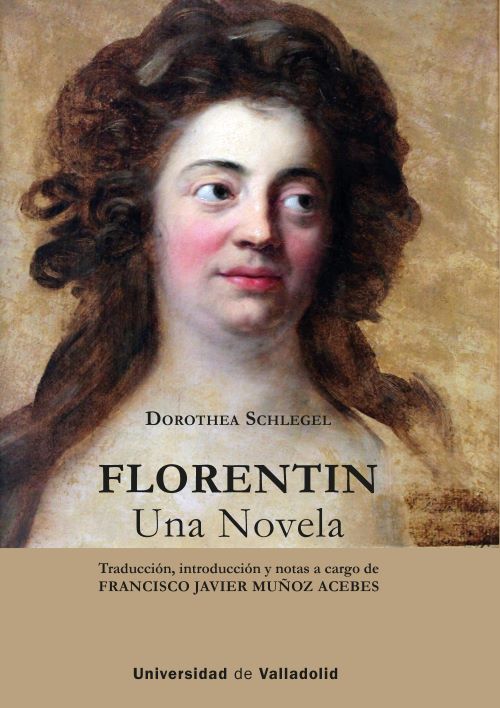
Florentin. Una novela
Keywords:
Early Romanticism, Women's literature, Dorothea Schlegel , Jena CircleSynopsis
Florentin (1801) is the only completed novel by Dorothea Schlegel (1764–1839), daughter of the Jewish Enlightenment philosopher Moses Mendelssohn and a central figure in the Jena Romantic circle. It was published anonymously — under the editorial name of Friedrich Schlegel — in Lübeck in 1801, in the first edition bearing the Bohn imprint, a circumstance that for decades obscured the female authorship of the work. The novel belongs to early German Romanticism (Frühromantik) and is directly related to Friedrich Schlegel's Lucinde (1799). In the novel, Dorothea Schlegel critically engages with the dominant conceptions of identity in German thought of the time, exploring themes such as androgyny, female emancipation, and the search for selfhood.
Despite its canonical relevance in studies of German Romanticism and gender, Florentin lacks a complete and annotated translation into Spanish that is widely available, which limits its accessibility both in university teaching and in research. This translation and introductory study aims to:
-
Integrate the female voice of German Romanticism into Spanish-speaking curricula in Germanic philology and comparative literature
-
Situate the work within the debate on gender, authorship, and canon in early Romanticism
-
Analyse the intertextual dimension with Lucinde, Novalis's Heinrich von Ofterdingen, and Tieck's Franz Sternbalds Wanderungen
References
Becker-Cantarino, B. (2000). Schriftstellerinnen der Romantik: Epoche – Werke – Wirkung (pp. 112–149). München.
Bitencourt dos Santos, V. C. (2024). Dorothea Schlegel: emancipação feminina e escrita na primeira fase do romantismo alemão [Tesis doctoral, Universidade Federal de Minas Gerais].
Brandstädter, Heike; Jeorgakopulos, Katharina (2001). Dorothea Schlegel Florentin: Lektüre eines vergessenen Textes. Hamburg: Argument Verlag.
Breuer, U. (2017). I. Lebensstationen. En J. Endres (Ed.), Friedrich Schlegel Handbuch: Leben – Werk – Wirkung (pp. 1–32). Stuttgart.
Deibel, Franz (1905), Dorothea Schlegel als Schriftstellerin im Zusammenhang mit der romantischen Schule, Berlín, Mayer und Mueller.
Dieckmann, L. (Ed.). (1980). Sammlung von Memoiren und romantischen Dichtungen des Mittelalters aus altfranzösischen und deutschen Quellen (Kritische Friedrich-Schlegel-Ausgabe, 3. Sektion: Editionen, Übersetzungen, Gutachten, Bd. 33). Paderborn et al.
Ezekiel, Anna (2020), Women, Women Writers, and Early German Romanticism, en Elizabeth Millan (ed.), Palgrave Handbook of German Romantic Philosophy, Palgrave-macmillan.
Fuchs, R. T. (2024). Women Writers’ Philosophy of Love in German Romanticism: Dialogical Life in Letters. Brill.
Genette, G. (1980). Narrative discourse: An essay in method (J. E. Lewin, Trans.). Ithaca, NY: Cornell University Press. (Original francés publicado en 1972)
Helfer, Martha B. (1996), Dorothea Veit-Schlegel's Florentin: Constructing a Feminist Romantic Aesthetic, The German Quarterly, Spring, 1996, Vol. 69, No. 2 (Spring, 1996), pp. 144-160
Jungk, C., & Wernli, M. (2026). Mit auf den Weg gegeben: Transkription und Annotationen zu einem ewigen Kalender Dorothea Schlegels als Geschenk für Felix Mendelssohn Bartholdy und Cécile Jeanrenaud. In F. Middelhoff & M. Wernli (Eds.), Mit rasender Freude dichten: Zum Werk Dorothea Schlegels (Neue Romantikforschung, Bd. 10). Berlin et al.
Jungk, C., Lindemann, A., & Porzer, T. (Eds.). (2026). Dorothea Schlegels letzte Lebensjahre (1829–1839) (Kritische Friedrich Schlegel Ausgabe, 3. Sektion, Bd. 32.1). Paderborn et al.
Löwe, M. (2017). Universalpoesie. In J. Endres (Ed.), Friedrich Schlegel Handbuch: Leben – Werk – Wirkung (pp. 331–333). Stuttgart.
Malcolm, D. (2018). Ellipsis, narrative gaps, and their functions in contemporary British poetry: A narratological approach. Tekstualia, 1(4), 67–80.
Middelhoff, F., & Wernli, M. (Eds.). (2026). Mit rasender Freude dichten: Zum Werk Dorothea Schlegels. Berlin.
Muñoz Acebes, F. J. (2006). El «Florentin» de Dorothea Schlegel: ¿una novela del romanticismo temprano? Estudios filológicos alemanes: revista del Grupo de Investigación Filología Alemana, 12, 279–292.
Muñoz Acebes, F. J. (2022), La monja cautiva en las novelas del Romanticismo Temprano Alemán. Illuminazioni, 62, pp. 54-76.
Nehring, W. (1993). Dorothea Schlegel: Florentin. Ein Roman (pp. 285–324). Stuttgart: Reclam.
Petersdorff, D. von, & Breuer, U. (Eds.). (2015). Das Jenaer Romantikertreffen im November 1799: Ein romantischer Streitfall (Athenäum: Jahrbuch der Friedrich Schlegel-Gesellschaft, 25).
Pnevmonidou, Elena (2005). Die Absage an das romantische Ich: Dorothea Schlegels Florentin als Umschrift von Friedrich Schlegels Lucinde. German Life and Letters, 58.3 (July 2005), 271-92.
Raich, J. M. (ed.) (1881), Dorothea Schlegel und deren Söhne Johannes und Philipp Veit: Briefwechsel, Mainz, Franz Kirchheim.
Roberts, F. C. (2002). The perennial search for paradise: Garden design and political critique in Dorothea Schlegel's Florentin. The German Quarterly, 75(3), 247–264.
Schlegel, Dorothea (1913). Briefe an Schleiermacher. Berlín, Heinrich Meisner und Erich Schmidt
Schlegel, Friedrich (1967). Kritische Friedrich-Schlegel-Ausgabe. Edición de Ernst Behler, Jean-Jacques Anstett y Hans Eichner. Vol. II. München – Paderborn – Wien – Zürich.
Snow, K. (2007). Powerful women: An analysis of Dorothea Schlegel’s Florentin (Master’s thesis). The University of Georgia, Athens, GA.
Stephan, Inge (1991). Weibliche und männliche Autorschaft : Zum »Florentin« von Dorothea Schlegel und zur »Lucinde« von Friedrich Schlegel. En Stephan, Inge; Weigel, Sigrid; Wilhelms, Kerstin (Hrsg.): “Wen kümmert's, wer spricht”. Zur Literatur und Kulturgeschichte von Frauen aus Ost und West, Köln: Böhlau, 83-98.
Stern, Carola (1993). Ich möchte mir Flügel wünschen: Das Leben der Dorothea, Reinbek bei Hamburg, Rowohlt.
Wanning, B. (2017). Familienbande. In J. Endres (Ed.), Friedrich Schlegel Handbuch: Leben – Werk – Wirkung (pp. 56–61). Stuttgart.
Weissberg, Liliane (1995), Schreiben als Selbstentwurf. Zu den Schriften Rahel Varnhagens und Dorothea Schlegels, Zeitschrift für Religions- und Geistesgeschichte, Vol. 47, No. 3, pp. 231-253.