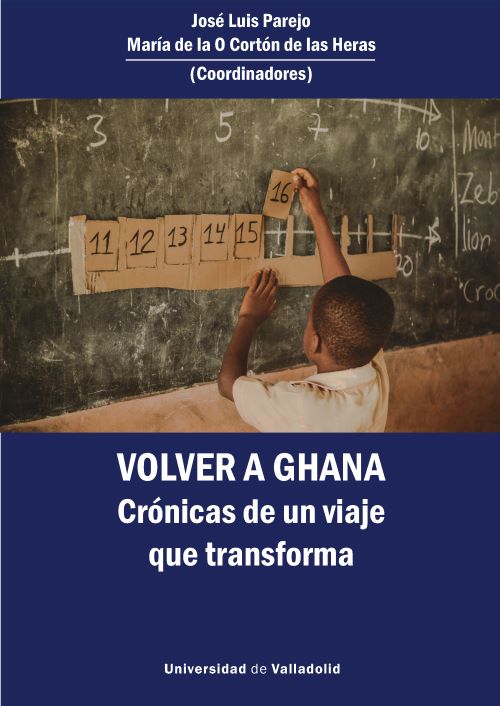
Returning to Ghana: Chronicles of a Transformative Journey
Keywords:
Cooperation, Education, Practicum, Service-Learning, GhanaSynopsis
This book is a collaborative work that brings together a selection of testimonies written by students from various degree programs at the University of Valladolid as part of the Ghana Practicum project, developed in collaboration with the NGO ADEPU over more than a decade. The first part of the publication compiles chronicles originally published in blog format and reorganizes them into a section structured around five main themes: volunteer experiences, education, culture and history, society, and the environment. From an educational perspective, the book documents a service-learning model in the Global South that transcends conventional academic practice. The placements, carried out primarily in the local communities of Atsiame and Larabanga, represent an extended immersion in educational and social contexts marked by material limitations, linguistic diversity, and strong community ties. The narratives reveal processes of personal and professional transformation characterized by the development of empathy, resilience, ethical responsibility, and critical awareness of North-South inequalities. The educational section includes reflections on teaching methodologies, curriculum adaptation, and intercultural collaboration with local faculty. The chapters dedicated to culture and history challenge Western stereotypes about Africa and advocate for contextualized and pluralistic perspectives. The social section addresses issues such as the role of women, community organization, and local development dynamics. Finally, the environmental section analyzes challenges related to waste management, deforestation, and sustainability, incorporating local initiatives for ecological empowerment. Overall, the work constitutes a collective memory that champions the University as a space for social commitment, intercultural dialogue, and holistic education, positioning educational cooperation as an experience of reciprocity and mutual learning.
The second part of the book adopts the format of a collective travelogue, interweaving personal narratives, pedagogical reflections, and images that document firsthand learning experiences. Far from being a conventional academic report, the work offers a collective narrative that captures processes of personal and professional transformation resulting from intercultural encounters. Through these diverse voices, the book highlights how participation in international educational cooperation experiences can contribute to the development of key competencies for teacher training, such as empathy, resilience, adaptability, and critical awareness of global inequalities. The photographs accompanying the testimonies do not aim to explain the reality depicted, but rather to invite a careful look at the educational and social contexts in which the experience unfolds. In this way, the book positions itself at the intersection of memory, education, and aesthetic experience, proposing a reflection on the formative potential of human encounters and situated learning. It is a collective testimony to the value of experiential learning in intercultural contexts and to the transformative power of education when it is based on dialogue, cooperation, and the recognition of diversity. More than a narrative about Ghana, the book offers a reflection on the process of learning to see the world from other perspectives and on how these experiences continue to resonate with those who have lived through them long after their return.
Downloads
Published
Categories
Right Holder
Ediciones Universidad de Valladolid y autor(es)/autora(s) 2026License

This work is licensed under a Creative Commons Attribution-NonCommercial-NoDerivatives 4.0 International License.